Have you noticed dry rot in your home? Bad news: you’re dealing with a moisture problem. Dry rot can only grow on damp walls and ceilings. So you not only need to combat the dry rot but also eradicate the moisture problem at its root. Here you can read how to combat dry rot and what you need to consider.
What Causes Dry Rot?
Dry rot can only occur when one or more walls are dealing with moisture problems. If you notice dry rot in the basement, storage room, bathroom, or another space, you should contact a moisture expert. The dry rot itself is merely the consequence; the cause lies with moisture.
Dry rot usually occurs due to condensation. That’s why dry rot is especially common in wet spaces. In these spaces, there’s a lot of water vapor in the air, for example after taking a shower or preparing a meal. This water vapor then condenses on cold surfaces such as windows, mirrors, walls, or ceilings. Water droplets form there, which penetrate the building material and form damp spots. And it’s these damp spots that form the ideal breeding ground for dry rot.
Furthermore, dry rot also occurs in spaces that are poorly insulated, receive little light, and where humidity is high because ventilation is not possible. Dry rot feeds on minerals in the building material and is especially common on wooden structures. That’s why you also find dry rot in the basement and in the attic.
Is Dry Rot Dangerous?
Dry rot is anything but harmless. The fungi spread with fungal threads that can penetrate deep into the building material. In addition, they also feed on the wood on which they grow, causing the wood to become less strong. This can lead to dangerous situations, especially when the dry rot grows on load-bearing support beams.
Moreover, the underlying moisture problem is not harmless either. Damp bricks lose their stability and also attract molds. These molds reproduce with harmful spores that can cause respiratory complaints. So you’d rather be rid of dry rot, moisture, and molds than have them.
What Does Dry Rot Look like?
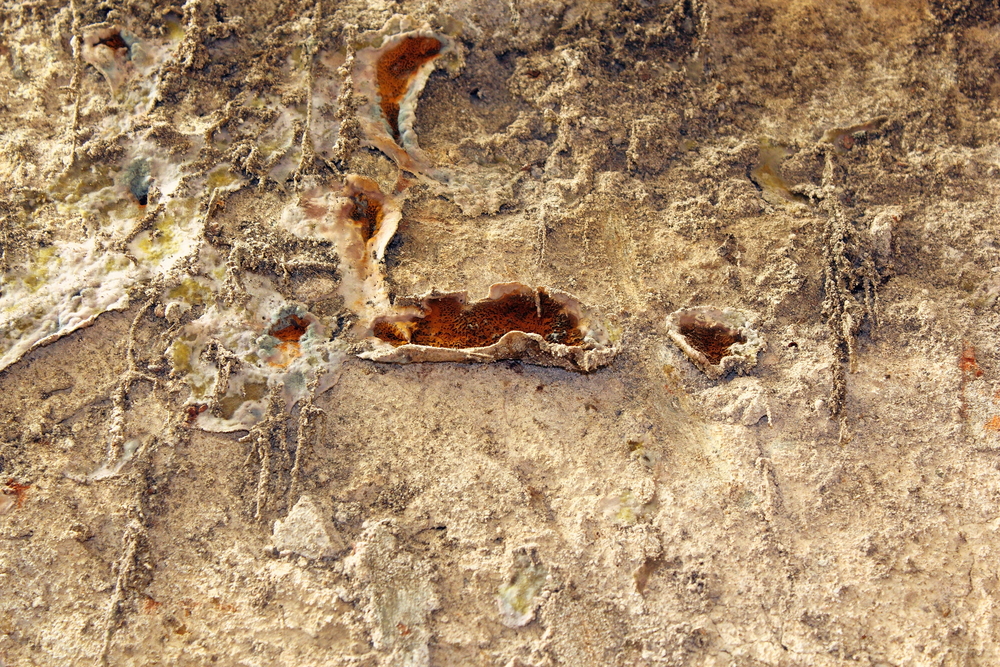
Dry rot is very easy to recognize, but only when it’s fully developed. The dry rot consists of a patch of brown layers with white edges. This patch can become up to two centimeters thick. At the ends, you can see white fungal threads that spread like a spider web across the wall.
In its early stages, dry rot is difficult to see, but you can notice a specific, dull smell. Later, the fruiting bodies then appear.
Fungi mainly develop in spaces with little light where moisture hangs in the air and that are poorly ventilated. You’ll find dry rot especially in bathrooms, kitchens, basements, attics, storage spaces, and they also often occur in wooden garden sheds.
How Can You Combat Dry Rot?
There are products on the market that you can buy in DIY stores, but unfortunately, they don’t work deeply enough. Such products only remove the fruiting bodies but are not strong enough to combat the fungal threads that are deeper in the wood or building material. As a result, the dry rot will quickly return.
Address the Underlying Moisture Problem
Moreover, it’s essential to address the moisture problem itself. If you do nothing about the high humidity in the space, molds and dry rot will continue to grow there.
If it’s condensation, it’s essential to ventilate the space. If that’s not possible, for example in a basement or in a bathroom without a window, we recommend installing a mechanical ventilation system. Only this way can you get rid of the dry rot once and for all.
The moisture in the wall can also have other causes. If the dry rot grows at the bottom of the wall, there may be rising damp. Water from the ground has then managed to penetrate the bricks. This can happen when the damp proof course no longer functions properly. Wall injections offer the solution in this case. In basements, cellar tanking is often necessary.
What Does Dry Rot Treatment Cost?
How much dry rot treatment costs depends on the extent of the moisture problem. We can only provide you with a quote after a thorough inspection. Only then can we say with certainty what the cause of the moisture problem is and how we can address it. This can be quite different.
- Is it rising damp? Then wall injection is needed, or possibly underpinning of the wall.
- Is condensation the troublemaker? Then a ventilation system is necessary.
- Are the dry rot and moisture in the cellar? Then cellar waterproofing and possibly cellar ventilation will solve the problem.
The cause of the problem determines the treatment. And each treatment has a different price tag. Therefore, contact us so that we can make an accurate diagnosis.
Solusio Combats Dry Rot in your Home
Are you dealing with dry rot? Then it’s important to take action quickly. The sooner you have an expert come by to combat the dry rot, the easier it is to get rid of. However, it’s especially important to also address the cause of the problem.
Solusio helps you combat moisture and dry rot. This way, you live in a healthy environment and prevent damage to your home. Contact us for free advice and make an appointment.