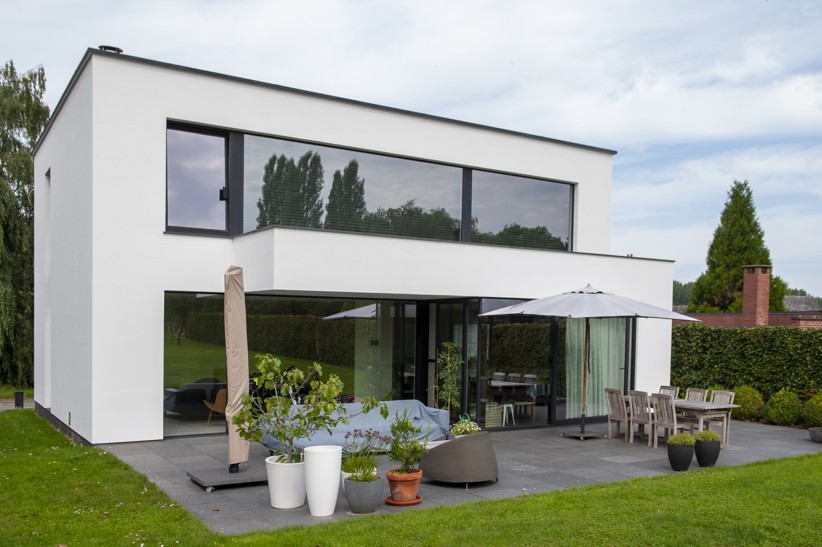
Crepi literally gives your home a new look. If you’re considering renovating your home with crepi, we recommend insulating the exterior facade at the same time. Or if you’re planning to insulate your exterior walls, crepi is the ideal facade cladding. In other words, crepi and facade insulation go hand in hand.
But which insulation is best to use when you want to cover the facade with crepi? We’ll tell you below.
Why is it Better to Insulate under Crepi?
You don’t have to insulate the facade when you want to apply crepi. Crepi can be applied perfectly on the facade itself. You have the choice between mineral crepi or synthetic crepi, where artificial resin has been added to the mixture. The advantage of mineral crepi is that you can apply it in thick layers, ideal for smoothing out unevenness in the facade. Synthetic crepi, on the other hand, is water and scratch resistant. This means you won’t have to deal with algae, moss, or other dirt on the crepi.
But it’s still a good idea to provide a layer of insulation between the facade and the crepi. Facade insulation is particularly efficient. You will see your energy bill decrease significantly and the value of your home will increase.
In times when EPC scores also weigh more heavily in the sale of a house, we certainly recommend facade insulation as part of the work to be carried out.
You also don’t need to carry out any work on the inside of your home. Insulating the exterior facade is quick, you don’t lose any space, and you quickly earn back your investment. And an additional advantage is that the insulation layer also has a sound-dampening effect. This way, you’ll also have less trouble with passing cars or loud lawnmowers, hedge trimmers, or other noise in the neighborhood.
How Does it Work, Insulating in Combination with Crepi?
Applying crepi in combination with facade insulation is quite fast. But the work does require some expertise.
1. Preparing the Facade for Insulation and Crepi
First of all, the facade must be thoroughly cleaned. Any cracks or fissures must also be repaired. We can only successfully carry out the work when the facade is nicely even. This is especially true when you’re only applying crepi, without insulation. The crepi can only adhere to smooth and cleaned surfaces.
Applying Insulation to the Facade
Then we apply the insulation layer. You can determine the thickness of the insulation yourself, but in general, that layer will be between 6 and 12 centimeters thick. We usually use EPS panels, but neopor insulation is also common.
Applying Crepi to the Facade
We usually work with reinforcement and profiles. This allows the crepi to adhere even better to the facade and makes the whole sturdy and strong. We also always apply a primer product to the facade, a kind of intermediate layer or primer that allows the crepi to adhere even better.
And finally, we apply the decorative plaster. This can be mineral or synthetic crepi . By the way, you don’t have to choose the classic white crepi, there are more than 400 different colors. You also determine whether you want a smooth or grainy crepi and how thick those grains should be.
How much Does Crepi and Insulation under Crepi Cost?
Crepi is a relatively budget-friendly facade cladding. If you choose to cover your facade with crepi without insulation, you should count on a price between 45 and 75 euros per m².
However, we recommend insulating at the same time. You then pay between 100 and 150 euros per m². That’s a certain investment, but you save money in the long run. And as we said earlier, the value of your home also increases.
What factors determine the exact price of facade insulation? The type of insulation and the thickness of the insulation layer. Each type of insulation has a different price tag. Moreover, the more insulation you need, the more you will have to pay.
Is Textured Plaster Low Maintenance?
Textured plaster is a low-maintenance facade cladding. When you notice dirt or green deposits on the textured plaster, it’s usually sufficient to use a pressure washer. We do advise you to limit the pressure of the water jet to avoid causing damage. Synthetic textured plaster has the advantage of being extra water-repellent, making it even more low-maintenance than mineral textured plaster.
However, prevention is better than cure. We always recommend applying a protective hydrophobic treatment after installing textured plaster with insulation. Our experts then treat the textured plaster with a hydrophobic agent . This makes the textured plaster completely water-repellent. Dirt simply washes away, and moss and algae don’t find a suitable breeding ground on your facade. This way, the white textured plaster facade remains in perfect condition for years.
Solusio Applies Textured Plaster with Insulation
The experts at Solusio have extensive experience in applying textured plaster and insulation. Our craftsmen are happy to give your home a new look. Thanks to the combination of textured plaster and insulation, your home not only looks like new, but you will also save significantly on your energy bill, and the value of your property will increase. Contact us for free advice or make an appointment.