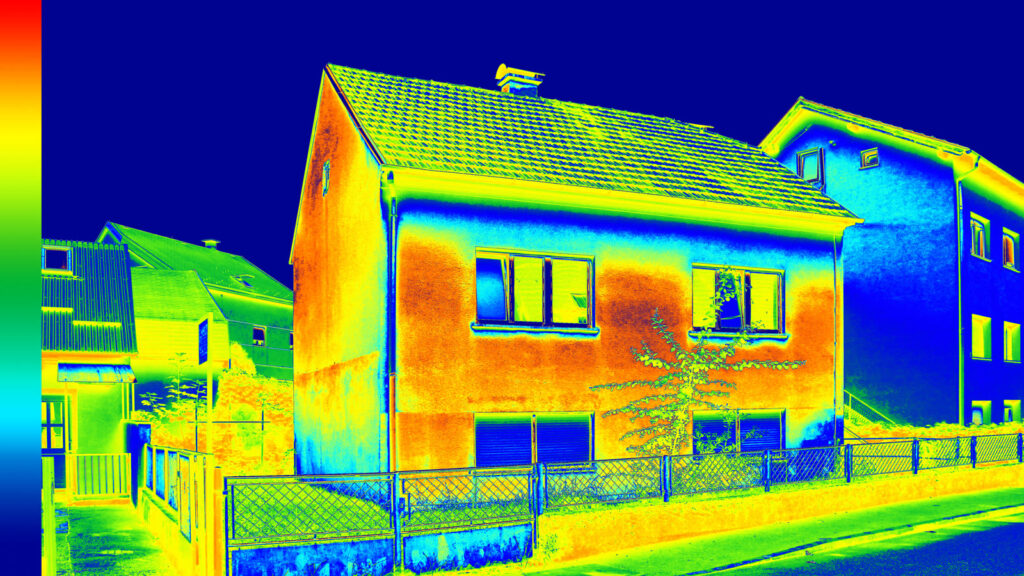
A black corner, damp patch, or strip of mould is often immediately labeled a thermal bridge. However, the same damage can also be caused by rising damp, water infiltration, condensation, or a leak. Recognizing the correct cause is important, as every form of damp requires a different treatment.
A thermal bridge is not an opening through which water flows. It is a point in the building envelope where heat is lost more easily. The inner surface becomes colder there, allowing moisture from the indoor air to condense locally and mould to develop.
What is a thermal bridge?
A thermal bridge, also known as a structural junction, occurs where the insulating layer is interrupted, thinner, or difficult to connect. This happens, for example, at a concrete lintel, balcony slab, floor-to-wall connection, window reveal, or the transition between roof and facade.
In such places, the surface temperature is lower than on the rest of the wall. When the air in the house is sufficiently humid, the relative humidity rises right against that cold surface. Condensation can occur, followed by mould.
Which signs indicate a thermal bridge?
Damage caused by a thermal bridge often appears in predictable architectural locations. Think of a black line in an external corner, mould around a window, discoloration against the ceiling, or a cold strip at the level of a concrete beam.
The problem usually becomes clearer during cold months. The area feels colder than the surrounding wall, and the damage pattern often follows the shape of the cold building detail. Mould can be more severe behind a cupboard or curtain because the air circulates less there.
How does a thermal bridge differ from rising damp?
Rising damp starts at the bottom of the wall and draws into porous materials from the ground. You often see peeling paint, loosening plaster, and white salt deposits in the lower zone of the wall.
A thermal bridge can also occur low to the floor, but it is more strongly related to temperature, humidity, and the building detail. Salt formation and a moisture front rising from the ground are more characteristic of capillary moisture.
How does a thermal bridge differ from water infiltration?
Water infiltration often reacts to rain. A spot becomes darker after driving rain, a downpour, or a defect in the gutter, facade, or window. The damage does not necessarily coincide with the coldest part of the wall.
With condensation caused by a thermal bridge, the link with low outdoor temperatures and high indoor humidity is generally stronger. Nevertheless, problems can be combined. For example, a facade moistened by rain cools down faster, which also increases the risk of condensation.
Can a moisture meter show the difference?
A simple moisture meter only provides an indication. Salts, material type, and surface temperature can influence the measurement. Therefore, a diagnosis is never based on a single measured value.
A combination of visual inspection, moisture measurements, temperature measurements, and monitoring of relative humidity provides a more reliable picture. Under suitable conditions, thermography can reveal where surfaces are colder, but those images must also be interpreted correctly.
What can you check yourself?
Note when the spot changes. Does it get worse after rain, during cold periods, or after showering and cooking? Measure the relative humidity and compare the temperature of the spot with the rest of the wall. Also check joints, sills, roof edges, and rainwater drainage outside.
Temporarily move furniture away and ensure air circulation. Stable heating and controlled ventilation can reduce condensation. In its information on insulation and airtightness, the Flemish government points out that accurate installation helps avoid thermal bridges and that ventilation remains necessary.
How is a thermal bridge solved?
The best solution is to thermally improve the cold building detail. This can be done, for example, by extending external insulation, correctly insulating window reveals, or repairing an interrupted insulation layer. Which intervention is possible depends on the construction.
Ventilating and heating reduce the risk of condensation but do not remove the structural thermal bridge. Conversely, extra insulation does not solve a leaking pipe or penetrating damp. That is why the diagnosis always comes before the treatment.
Have the real cause determined
The difference between a thermal bridge and a damp problem is not always clear to the naked eye. Incorrect treatment can temporarily hide the damage while the cause persists.
Does mould or damp keep returning to the same place? Request a free site visit from Solusio. We investigate the damage pattern and advise on a solution that fits the real cause.