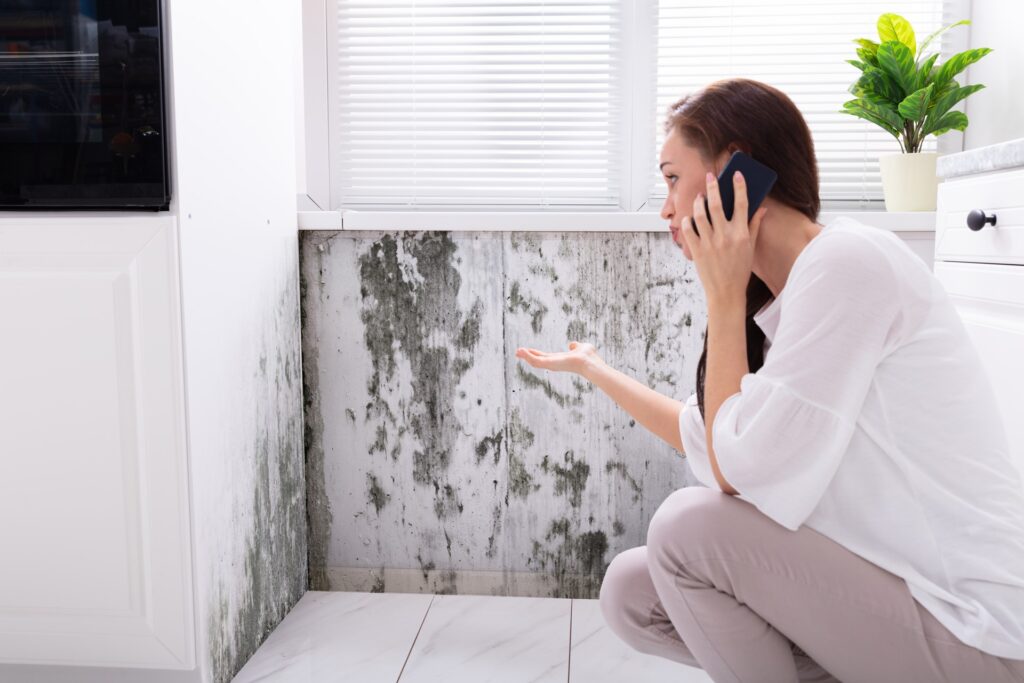
Do you see white, powdery patches appearing on your wall? Or does it look like salt crystals are growing out of the plasterwork? Then you are likely dealing with saltpeter. . It looks harmless, but it is almost always a clear signal of an underlying moisture problem.
Where does that saltpeter on the walls come from? And more importantly, how do you combat that annoying white deposit?
What exactly is saltpeter?
Saltpeter is not a mold, but a salt efflorescence. It occurs when moisture in the wall carries soluble salts to the surface. When the moisture in the walls evaporates, those salts remain behind on top of the bricks or the plaster. They form white crystals that have a powdery appearance.
Saltpeter often occurs on basement walls, ground-floor interior walls, and generally in older homes, but it can basically arise anywhere moisture is present in the wall. Important to know: saltpeter is not a cause, but a consequence. The real problem is always moisture.
How does saltpeter develop?
To understand why saltpeter appears, you first need to understand how moisture behaves in walls. Walls are porous. This means that bricks are full of small openings through which moisture can penetrate. Bricks can pull up water like a sponge.
When water moves through the wall in this way, it dissolves the salts naturally present in bricks or mortar. It can also happen that the water carries salts from the ground and brings them into your bricks. Because we heat our rooms, that moisture eventually evaporates. The salts then remain behind as white spots on the walls.
The main causes of saltpeter on walls
1. Rising damp
The most important cause of saltpeter is rising damp. This is ground moisture that pulls up into the walls via the foundation. Normally this should not happen, because every home is theoretically equipped with a damp-proof course that stops moisture. However, in older homes, this is often missing or the layer has become damaged.
Typical characteristics of rising damp:
- Saltpeter at the bottom of the wall on the ground floor, up to about one and a half meters high
- Peeling paint or loose wallpaper
- Musty smell
2. Penetrating damp
Saltpeter can also be caused by penetrating damp. In this case, rainwater penetrates inward through the exterior facade. This can happen with old facades with damaged joints. These form cracks through which rainwater has free rein. Rainwater that penetrates carries salts through the bricks. This is how salt deposits can also appear. The culprit of the story is then the facade.
3. Moisture in basements
Basements are particularly sensitive to saltpeter. They are in direct contact with the ground, and the basement walls must contend for decades with the salt-rich groundwater surrounding the bricks everywhere. Especially when the water pressure is high in your region, moisture in the basement is often a matter of time.
Why is saltpeter a problem?
Saltpeter looks ugly, but even more importantly: it indicates an active moisture problem that can cause structural damage.
Damage to plaster and paint
Salt crystals expand when they absorb moisture. This expansion can cause plasterwork to crumble and paint to peel off. Even if you repaint the wall without addressing the moisture problem, the saltpeter will return.
Structural degradation
In the long term, persistent moisture can weaken the masonry. Mortar can become brittle and bricks will suffer damage.
Unhealthy indoor climate
Damp walls create an environment in which molds develop more easily. You are always better off without them. Molds spread with toxic spores. When you breathe these in, you can develop health problems. Coughing fits, respiratory problems, headaches, and fatigue are typical complaints. It is also these molds that bring the typical musty, dull moisture smell with them.
Why does saltpeter keep coming back?
Simply brushing away or painting over saltpeter does not help, of course. It will temporarily rid the walls of that white powder, but the source of the problem remains. And so saltpeter will always return, no matter how often you bring out the brush. What’s more, those salts on the wall in turn attract water vapor. They thus keep the walls damp and create a vicious circle.
Solutions for saltpeter
Tackling saltpeter always starts with finding the cause. Removing the white deposit itself makes little sense if the underlying moisture problem is not solved. Therefore, you should contact a moisture control specialist. Depending on exactly where the moisture is coming from, we then start an appropriate treatment. Each type of moisture problem requires a different moisture control method:
- For rising damp – a damp-proof injection is often the solution. This involves injecting a water-repellent agent into the wall that forms a new barrier against ground moisture.
- For penetrating damp – we must first repair the facade and then protect it with a hydrofuge (facade impregnation) to keep rainwater out.
- For basement problems – a full basement tanking or drainage is often necessary to hold back the water pressure.
Solusio combats saltpeter and moisture in your home
The most important thing to remember: saltpeter is always a signal. It indicates moisture in the wall. Anyone who only removes the white deposit without addressing the moisture problem is treating the symptom but not the cause. The longer you wait, the larger the moisture problem becomes.
At Solusio, we investigate where the moisture is coming from and propose a sustainable solution that drives that moisture away once and for all.
Suffering from saltpeter on your walls? Contact us today without obligation for a free moisture diagnosis.