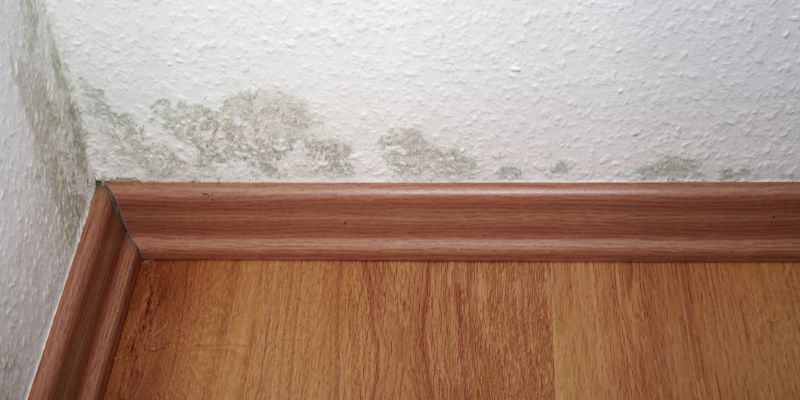
Do you notice skirting boards coming loose from the wall? If so, there is a high probability that there is more going on than just a poorly glued board. Damp behind skirting boards is often one of the first visible signs of a moisture problem in the wall. Especially in older homes, this symptom very often points to rising damp.
But what should you do then? And how does that moisture end up behind the skirting boards? You can read all about it below.
How does damp develop behind skirting boards?
In most cases, rising damp is the cause of moisture behind skirting boards. Rising damp occurs when groundwater slowly pulls up into the walls via the foundation. Normally, a damp-proof course prevents this, but in older homes, it is often missing or has become damaged over time. As a result, ground moisture has free rein and rises through the pores in the masonry.
Because skirting boards are located at the very bottom of the wall, they are usually the first place where the consequences become visible. The moisture pulls into the plasterwork and subsequently reaches the skirting boards as well. The wall expands, begins to warp, and the skirting boards come loose. If you have wooden skirting boards, they can absorb the moisture and begin to swell.
Please note, rising damp is the cause of loosening skirting boards in most cases, but something else could also be going on. A localized leak, for example, could be the source of the moisture. In other cases, penetrating damp could be the cause, although that is much less likely.
How do you recognize rising damp behind skirting boards?
Loosening skirting boards are rarely the only symptom. Usually, there are other signals that point to rising damp. Common characteristics include:
- damp patches at the bottom of the wall
- peeling paint or loosening wallpaper
- damaged plasterwork
- white salt efflorescence on the wall
- a musty smell in the room
Rising damp generally rises to about one meter above the floor. Therefore, the moisture problems usually remain limited to the lower zone of the wall. That is another clear signal.
What are the consequences of damp behind skirting boards?
Those who ignore damp behind skirting boards often notice that the damage slowly but surely gets worse. After all, rising damp does not disappear on its own. As long as the wall continues to absorb groundwater, the damage will continue to increase.
Damaged finish
The first damage is usually visible in the finish of the wall. Skirting boards come loose, paint begins to peel, and plasterwork crumbles. If you only replace the skirting boards without addressing the cause, you will notice that the new boards will also come loose again over time.
Mould and an unhealthy indoor climate
Damp walls form an ideal breeding ground for mould. Furthermore, they often cause a musty smell in the house and a less healthy indoor climate. People with allergies or respiratory complaints in particular may suffer from this.
Bad for the wallet
A moisture problem that drags on for years can also negatively affect the value of a home. Potential buyers are often deterred by visible moisture problems. But even when you are not planning to sell, you will notice moisture problems in your wallet. The longer you wait to treat it, the more complex and expensive the treatment becomes. Moreover, damp walls do not insulate well. You will therefore also have to heat more to keep your home warm.
How does Solusio tackle damp behind skirting boards?
If you suffer from rising damp, you should not treat the skirting boards, but the wall itself. That is why Solusio first investigates exactly where the moisture is coming from. If rising damp turns out to be the cause, a wall injection is in most cases the most efficient solution.
With a wall injection, we drill small holes in the bottom layer of the wall. We then inject a moisture-resistant gel that forms a new damp-proof course. Once it has fully cured, ground moisture can no longer pull upwards. After the treatment, the wall must be given time to dry out. Only then can you think about finishing and new skirting boards.
In exceptional situations, for example when the wall is very heavily affected or an injection is technically not possible, wall underpinning can be the best solution. In this process, we cut into the bottom of the wall and slide a new damp-proof course into the wall. This is an invasive treatment that we only recommend for major renovation works, but it is a definitive solution.
Damp behind skirting boards? Solusio can help you further
Loosening skirting boards are often not a minor finishing problem, but a clear signal that there is moisture in the wall. The faster the cause is addressed, the smaller the damage and the repair costs remain.
Are you dealing with damp behind your skirting boards? Then the moisture specialists from Solusio will come to find out exactly what the cause is. Afterwards, we can draw up a suitable treatment plan and expel moisture from your home once and for all. Contact Solusio today without any obligation.