How to solve condensation problems? Practical tips
Condensation occurs when humid air cannot escape and settles on cold surfaces, such as windows, walls, or ceilings. Although condensation problems occur in various forms, fortunately, you can also solve them in multiple ways. The right approach always depends on the cause and severity of the problem.
1. Install a ventilation system
When condensation occurs in multiple rooms, it’s almost always a sign that the humidity is too high.
A ventilation system, mechanical or partly natural, is then the best first step.
Benefits of ventilation:
-
continuously removes humid air
-
prevents mold formation
-
ensures a healthy indoor climate
-
prevents new condensation
At Solusio, we examine which ventilation system best suits your home: C-, D-, or hybrid systems.
2. Fix thermal bridges
Localized condensation often occurs due to a thermal bridge: a spot where cold from outside is directly transmitted inside.
This happens, for example, with:
-
transition between wall and floor
-
window connections
-
poorly insulated exterior walls
A thermal bridge must be structurally repaired or insulated.
If you don’t do this, condensation will always form again in that spot, even with good ventilation.
3. Reduce moisture production in the house
Small daily habits can cause a lot of moisture. Think of:
-
cooking without a range hood
-
showering without ventilation
-
drying clothes indoors
-
poorly ventilated spaces
Practical tips:
-
Turn on the range hood during and after cooking
-
Ventilate the bathroom for 20-30 minutes after showering
-
Avoid drying laundry indoors
-
Use a dehumidifier as a temporary solution
4. Check for underlying moisture problems
Sometimes it seems like condensation is the problem, but in reality, there’s:
-
rising damp
-
rising damp
-
leaks
-
damp basement
A free moisture diagnosis can quickly rule this out.
5. Work with an expert
The best solution always starts with correctly determining the cause.
If you only treat the symptoms, the condensation problem will return sooner or later.
At Solusio, we conduct a professional diagnosis and examine which solution works sustainably, from ventilation to insulation repair or moisture control.
Is the Moisture Problem Condensation?
If you’re dealing with moisture problems, the exact cause isn’t always clear and concrete. If you want to test whether it’s indeed condensation, you can do this with a so-called ‘condensation plate‘. You can easily make this plate yourself.
Cut a piece of aluminum foil about 15 x 15 cm and tape it with (painter’s) tape to one or more places where you suspect condensation formation. Then leave it for a few days. If the foil is moist on the outside after a few days, you can assume that there is condensation. The water vapor present in the air will adhere to the foil because the foil is a cold surface. However, if the foil is moist on the inside, you’re dealing with an external problem. You might, for example, have issues with penetrating moisture.
In any case, it’s advisable to consult an expert who can determine the exact cause.
How Do You Make a Condensation Plate Yourself?
You can easily test this at home:
-
Cut a piece of aluminum foil about 15 x 15 cm.
-
Tape the foil with painter’s or masking tape to the spot where you suspect condensation.
-
Leave it for a few days without touching it.
-
Then check if the foil is moist and especially on which side.
How Do You Interpret the Result?
Foil Moist on the outside = Condensation
In this case, the humid air in the room condenses on the cold surface of the aluminum.
This means that your moisture problem is caused by:
-
poor or insufficient ventilation
-
too high humidity in the room
-
cold surfaces (thermal bridges)
The solution then usually lies in improving ventilation, air circulation, and addressing thermal bridges.
Foil Moist on the Inside = External Moisture Problem
Is the foil on the wall side wet?
Then the moisture comes from the wall itself, and it’s not condensation.
Possible causes are then:
-
penetrating moisture through a porous facade
-
rising damp through the foundation
-
leaks or infiltration
-
moisture from the basement
In that case, your wall needs structural treatment, such as wall injection, facade impregnation, or basement sealing.
A condensation plate gives a good first indication, but for a definitive diagnosis, a professional analysis is necessary.
At Solusio, we measure the moisture values in the wall, determine the exact cause, and propose the best solution for your home.
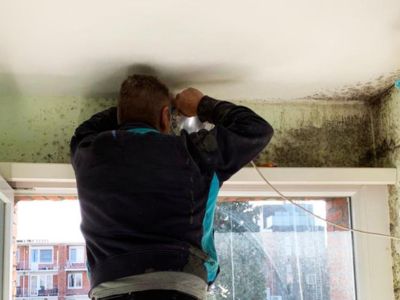
Solving Condensation Problems Yourself
For condensation problems, we always recommend consulting a specialized moisture expert.
Condensation may seem easy to recognize, but the underlying cause, such as thermal bridges, insulation problems, or ventilation defects, is not always immediately clear.
However, you can already take some practical steps yourself to lower the humidity in your home and temporarily improve the situation.
What Can You Do Yourself against Condensation?
1. Have ventilation grilles installed
Ventilation grilles provide a constant supply of fresh, dry air and remove humid air.
They are especially useful in rooms without windows or in well-insulated homes where air gets trapped.
2. Use a range hood in the kitchen
A lot of moisture is released during cooking.
A range hood that vents outside prevents this moist air from spreading throughout the home.
3. Open windows regularly
Daily short and intense airing helps replace humid air with dry outside air.
This is essential, especially in bathrooms, kitchens, and bedrooms.
4. Avoid extra moisture production indoors
-
Dry laundry outside, not in the living space
-
Leave the bathroom door open after showering
-
Use a dehumidifier as a temporary solution
By these simple measures, you can noticeably lower the humidity.
But Beware: this Doesn’t Solve the Cause
The tips above can help reduce the symptoms, but they usually don’t solve the real problem.
Persistent condensation often indicates:
-
insufficient ventilation,
-
a thermal bridge,
-
poor insulation,
-
or an underlying moisture problem such as rising damp or penetrating damp.
That’s why a professional diagnosis is essential.
Countering Localized Condensation with a Moisture Absorber
Do you have localized condensation, for example in a meter cupboard, storage room, technical space, or cabinet with a boiler? Then a moisture absorber can sometimes help temporarily.
A moisture absorber consists of a collection tray with a grid on which hygroscopic salts are placed. These granules draw moisture from the air and collect it in the reservoir. Once the granules are saturated, they need to be replaced again.
Important: a moisture absorber only addresses the symptoms, not the cause.
The underlying reason for the condensation, such as poor ventilation, a thermal bridge, or structural moisture, remains and will continue to cause problems.
Thorough Treatment against Condensation Problems
Do you want to be permanently rid of condensation, mold, and humid air?
Then the source of the problem must be addressed. This can only be done through a professional diagnosis.
At Solusio, we conduct a free, no-obligation moisture diagnosis where we, among other things:
-
measure the humidity,
-
detect thermal bridges,
-
identify ventilation problems,
-
and check if there are underlying moisture problems (rising damp, penetrating damp…).
Based on this analysis, you receive clear advice and a tailored solution to structurally eliminate the condensation problem.
Suffering from condensation at home?
Call toll-free 0800/61 667 or email info@solusio.be
for a free diagnosis and a sustainable solution by our experts.